Evaluating 100 Procreate 3D Female Hair Stamps for Digital Artwork
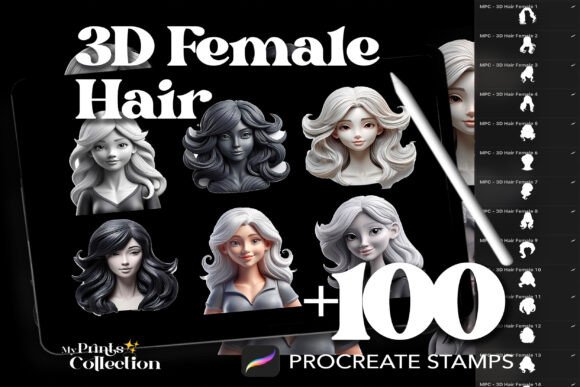
Digital illustration often hinges on the ability to render complex textures efficiently. Among the most challenging elements to draw from scratch is hair, particularly when aiming for a three-dimensional appearance that conveys volume, flow, and light interaction. For artists using the Procreate application on iPad, pre-made assets can significantly streamline this process. The 100 Procreate 3D Female Hair Stamps collection represents a specific category of digital tools designed to address these challenges. This resource provides a library of over one hundred unique brush stamps, each crafted to simulate the intricate anatomy of female hair with a distinct sense of depth.
While many artists prefer drawing every strand manually to maintain total control, the demand for speed and consistency in character design, portrait illustration, and concept art has driven the popularity of stamp-based workflows. Understanding what makes this specific set distinct, how it compares to other methods, and where it fits within a broader artistic toolkit is essential for anyone considering its adoption.
Understanding the Functionality of 3D Hair Stamps
The core value proposition of the 100 Procreate 3D Female Hair Stamps lies in its format: a .brushset file containing individual stamps rather than traditional stroke brushes. Unlike standard brushes that require the user to drag the stylus to create a shape, stamps place a pre-rendered image onto the canvas with a single tap. In this context, "3D" refers to the visual rendering of the hair clumps themselves. Each stamp is not merely a flat silhouette; it includes shading, highlights, and shadowing baked into the texture, giving the illusion of cylindrical volume immediately upon placement.
This approach differs fundamentally from procedural hair generation or manual painting. When an artist uses a manual brush, they must construct the form through layering, blending, and varying opacity. With the 100 Procreate 3D Female Hair Stamps, the foundational structure of the hair clump is already established. The artist's role shifts from construction to composition—deciding where to place these volumetric elements to build a cohesive hairstyle. This distinction is crucial for evaluating whether the tool aligns with a specific workflow.
The collection features diverse styles, ranging from loose curls and tight coils to straight bangs and flowing locks. Each stamp captures delicate details such as flyaways and the way light catches the edges of a hair section. Because these are high-resolution assets, they retain crispness even when scaled up or down within reasonable limits, ensuring that the final artwork does not appear pixelated or muddy.
Comparing Stamps to Manual Painting and Other Tools
To make an informed decision, it is necessary to compare the 100 Procreate 3D Female Hair Stamps against alternative methods available to digital artists. The primary alternative is manual painting, where the artist draws hair strands individually or in small groups using textured brushes. Another alternative involves using vector-based assets or third-party 3D modeling software to generate hair, which is then imported into Procreate as a reference or overlay.
Manual Painting vs. Stamping
- Control and Uniqueness: Manual painting offers the highest degree of customization. Every strand can be adjusted to fit the exact curvature of a head or the specific lighting conditions of a scene. However, this method is time-intensive and requires a strong understanding of hair physics and anatomy.
- Speed and Consistency: The 100 Procreate 3D Female Hair Stamps excel in speed. An artist can populate a head with hair in minutes rather than hours. Furthermore, because the stamps are pre-designed, the style remains consistent across different projects, which is beneficial for series work or branding.
- The Tradeoff: The tradeoff for speed is potential rigidity. If a stamp does not match the angle of the character's head perfectly, it may look disjointed. While Procreate allows for rotation and scaling, forcing a static image to conform to complex organic shapes can sometimes result in a "sticker-like" appearance if not blended carefully.
Comparison with Vector Assets
Vector-based hair assets offer infinite scalability without quality loss, but they often lack the painterly texture required for realistic digital paintings. The 100 Procreate 3D Female Hair Stamps are raster-based, meaning they integrate more naturally with painted backgrounds and skin tones. They possess the grain and softness associated with digital media, whereas vector imports can sometimes appear too clean or artificial unless heavily processed.
Strengths and Limitations in Practice
Every tool has a specific niche where it performs optimally. The strengths of this particular collection are evident in scenarios requiring rapid iteration or stylistic consistency.
Key Strengths
- Efficiency in Character Design: For character designers who need to iterate through multiple hairstyles quickly, these stamps allow for rapid prototyping. An artist can try five different hair volumes in the time it takes to sketch one manually.
- Accessibility for Intermediate Artists: Artists who understand composition but struggle with the technical execution of hair rendering will find these stamps empowering. They provide a professional look without demanding advanced brush mastery.
- Versatility Across Projects: The collection is not limited to full portraits. Individual stamps can be used to add texture to fashion illustrations, create pattern designs, or even serve as elements in tattoo flash art. The "nature" aspect mentioned in some descriptions suggests organic flow that mimics natural growth patterns.
Potential Limitations
- Blending Requirements: To avoid a flat look, users must still apply color adjustments, shadows, and highlights over the stamps. Simply placing them on a canvas is rarely sufficient for a finished piece. The stamps act as a base, not a complete solution.
- Repetition Risks: Using the same stamp repeatedly can lead to noticeable repetition, breaking the illusion of realism. Users must vary their selection from the 100 options and adjust scale and opacity to maintain variety.
- Resolution Constraints: While high-quality, raster stamps have a limit to how much they can be enlarged before losing definition. Extremely large-scale murals or prints might require higher resolution source files than a standard brush set provides.
Determining the Right Fit for Your Workflow
Deciding whether to incorporate the 100 Procreate 3D Female Hair Stamps into your toolkit depends largely on your project goals and current skill level. These stamps are an excellent choice for artists working under tight deadlines, such as freelance illustrators or content creators producing social media graphics daily. They are also highly suitable for hobbyists who want to achieve a polished aesthetic without spending years mastering hair rendering techniques.
However, there are situations where this tool may not be the right fit. If your goal is hyper-realism where every individual strand must react uniquely to a specific light source, manual painting or dedicated 3D hair simulation software followed by painting over the render might yield superior results. Similarly, if you are creating a very stylized, abstract piece where hair is represented by simple lines or blocks of color, the detailed nature of these 3D stamps might feel excessive or out of place.
Another consideration is the learning curve for integration. While the import process is instant, utilizing the stamps effectively requires an understanding of layer modes (such as Multiply for shadows or Overlay for highlights) and masking. Without these skills, the stamps may sit on top of the artwork rather than becoming part of it.
Practical Application and Integration
Once the .brushset file is imported into Procreate, the workflow becomes intuitive. The artist selects a stamp from the brush library and taps the canvas. From there, the real work begins. A practical approach involves using the stamps to establish the major masses of the hair first. Once the silhouette and volume are defined, artists should switch to standard airbrushes or textured brushes to blend the edges of the stamps into the skin and background.
For example, when illustrating a portrait with long, wavy hair, an artist might use three or four different stamps from the collection to create the main body of the hair. By rotating the stamps slightly and adjusting their size, the hair appears less uniform. Subsequently, a low-opacity brush can be used to soften the transition between the stamped hair and the character's forehead or neck. This hybrid approach leverages the speed of the 100 Procreate 3D Female Hair Stamps while retaining the organic feel of hand-painted details.
In conclusion, the 100 Procreate 3D Female Hair Stamps offer a robust solution for artists seeking to enhance their efficiency and expand their stylistic range. They bridge the gap between technical difficulty and artistic output, providing a foundation that can be built upon. While they do not replace the need for artistic judgment or post-processing, they serve as a powerful asset for those looking to unlock endless possibilities in digital hair design without starting from zero. Whether for professional commissions or personal exploration, evaluating this tool against your specific needs reveals a versatile option for modern digital illustration.